

The Future of Data Science: How Agentic AI Is Transforming Analytics in 2026
Just a couple of years ago, the phrase "AI agent" sounded like something straight out of a science-fiction movie. Today, it's quickly becoming one of the biggest technology trends shaping the future of business.
According to Gartner, task-specific AI agents are expected to become a major part of enterprise applications by the end of 2026. That isn't just another AI buzzword it's a fundamental shift in how organizations analyze data, make decisions, and automate everyday work.
For years, data science has focused on discovering patterns, building predictive models, and helping businesses make smarter decisions. Now, AI is beginning to take the next step. Instead of simply predicting outcomes, it can reason through problems, plan multiple actions, and even complete tasks with minimal human intervention.
That's exactly where Agentic AI comes in.
New to AI? Start with our Generative BI & Agentic AI Workflows guide to understand how intelligent AI systems are transforming modern business analytics.
📌 Quick Summary
- Agentic AI goes beyond predictions by planning, reasoning, and executing tasks autonomously.
- It is transforming data science from traditional analytics into intelligent decision-making.
- Core skills like Python, SQL, Machine Learning, LLMs, and Retrieval-Augmented Generation (RAG) remain essential.
- Rather than replacing data scientists, AI agents are becoming intelligent assistants that improve productivity and automate repetitive work.
What Is Agentic AI?
Think of a traditional AI model like a calculator. It's incredibly powerful but only after someone tells it exactly what to do.
An AI agent works very differently.
Instead of simply answering questions or generating content, it can plan a task, break it into smaller steps, remember previous context, make decisions, and execute actions with minimal human involvement.
Imagine giving an AI a simple goal:
"Find out why sales dropped in the North region and suggest the best solution."
Rather than only displaying charts or writing a report, an AI agent can automatically gather data, identify patterns, investigate possible reasons, recommend actions, and even prepare a complete summary for your team.
That's the biggest shift we're seeing today.
Traditional AI gives answers.
Agentic AI solves problems.
From Prediction to Autonomous Action
For decades, data science has been centered around one primary goal making accurate predictions.
A typical workflow looked something like this:
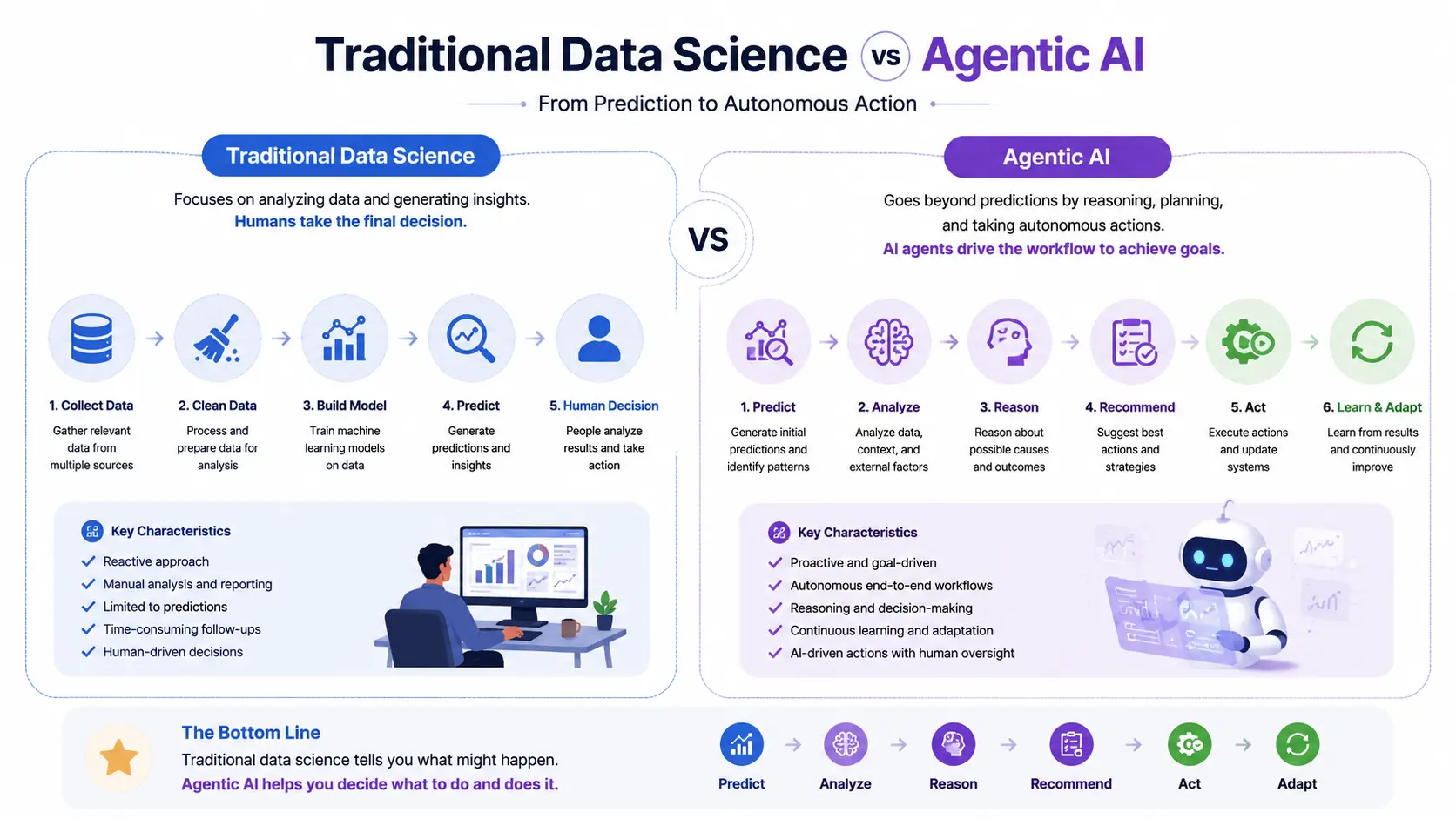
Collect Data → Clean Data → Build Model → Predict → Human Makes Decision
Once a prediction was generated, the responsibility shifted to people. Analysts interpreted dashboards, managers reviewed reports, and teams decided what action to take next.
Agentic AI changes that workflow completely.
Instead of stopping after prediction, AI agents continue working toward a goal by analyzing results, planning the next steps, and taking appropriate actions whenever possible.
Predict → Analyze → Reason → Recommend → Act
This may sound like a small change, but it fundamentally transforms analytics from a reporting tool into an intelligent decision-making system.
How Does It Work?
Imagine you're managing an online retail business and sales suddenly drop in one region.
A traditional analytics dashboard might simply display declining sales numbers and leave the investigation to your team.
An Agentic AI system, however, can continue the workflow automatically.
- 1. Detect the sudden drop in sales.
- 2. Compare historical sales patterns.
- 3. Analyze weather conditions, local events, marketing campaigns, and competitor activity.
- 4. Identify the most likely reason behind the decline.
- 5. Recommend inventory or pricing adjustments.
- 6. Notify managers with a complete summary and suggested actions.
Instead of answering "What happened?", Agentic AI begins answering "Why did it happen, and what should we do next?"
Real-World Example: Unilever
One of the best examples of AI-powered decision-making comes from Unilever.
Industry reports suggest the company combines internal sales data with external signals such as weather forecasts, seasonal demand, local events, and market trends to improve demand forecasting.
Rather than relying only on historical sales reports, AI continuously evaluates multiple data sources and helps optimize inventory planning, reducing unnecessary stock while improving forecasting accuracy.
This isn't simply better reporting it's AI supporting real operational decisions before problems become expensive.
Another Example: Microsoft
Microsoft is also expanding the capabilities of AI agents through Microsoft Copilot.
Instead of responding to a single prompt, modern AI agents can perform multi-step business workflows such as:
- 1. Summarizing long email conversations.
- 2. Scheduling meetings automatically.
- 3. Searching company documents.
- 4. Preparing reports.
- 5. Helping employees complete repetitive business tasks.
The goal is no longer just generating text it's helping people complete meaningful work faster.
Traditional Data Science vs Agentic AI
| Traditional Data Science | Agentic AI |
|---|---|
| Analyzes historical data | Analyzes data and takes intelligent action |
| Predicts future outcomes | Predicts, reasons, and executes workflows |
| Static dashboards and reports | Interactive AI agents |
| Human-driven decisions | AI-assisted decision making |
| Manual reporting and follow-up | Automated business actions |
💡 Did You Know?According to Gartner, by 2028 nearly 15% of everyday business decisions could be made autonomously by AI agents up from almost zero only a few years earlier. This highlights how quickly businesses are moving from predictive analytics toward intelligent automation.
The shift isn't happening overnight, but it's happening much faster than many professionals expected. Learning how AI agents think, plan, and collaborate with humans today could become one of the most valuable career investments for tomorrow.
Skills Every Modern Data Scientist Should Learn
The rise of Agentic AI doesn't mean traditional data science skills are becoming obsolete. In fact, they're more important than ever.
Many beginners make the mistake of jumping directly into AI agents, Large Language Models (LLMs), or Prompt Engineering without building a solid foundation first. While these technologies are exciting, they sit on top of core data science concepts not the other way around.
If you're serious about building a long-term career in AI, focus on mastering the fundamentals first and then gradually expand into modern AI technologies.
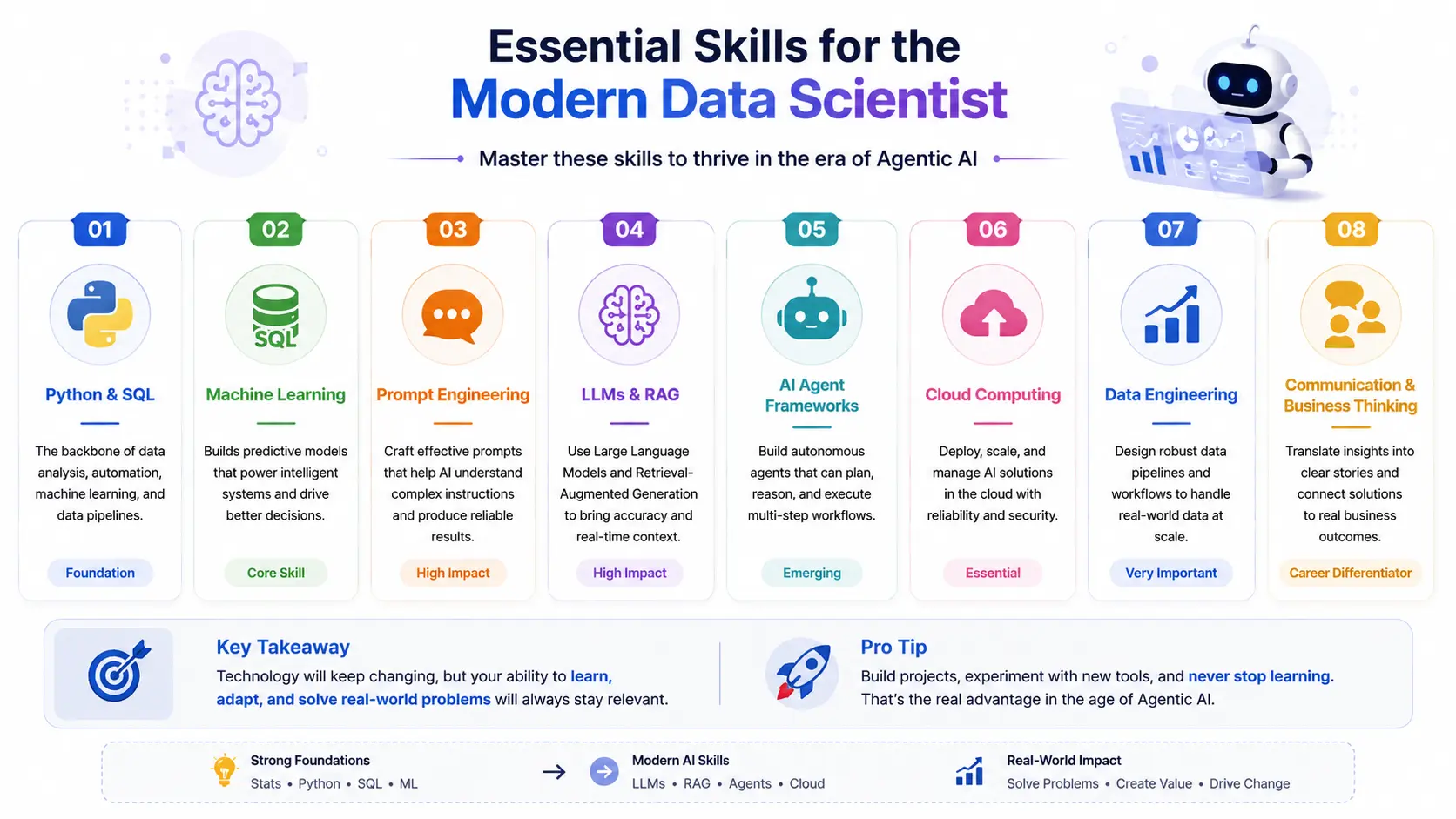
The following skills form the foundation of every modern Data Scientist working with Agentic AI.
| Skill | Why It Matters |
|---|---|
| Python & SQL | Still the foundation of data collection, analysis, automation, and machine learning workflows. |
| Machine Learning | Provides the predictive intelligence behind modern AI agents. |
| Prompt Engineering | Helps AI systems understand complex instructions and produce reliable outputs. |
| LLMs & Retrieval-Augmented Generation (RAG) | Enable AI agents to reason using accurate, up-to-date information instead of relying only on pre-trained knowledge. |
| AI Agent Frameworks | Used to build autonomous workflows, intelligent assistants, and multi-step AI systems. |
| Cloud Computing | Essential for deploying, scaling, and managing production-ready AI applications. |
| Communication & Business Thinking | Data scientists must explain insights clearly and connect AI solutions to real business problems. |
Although new AI tools appear almost every month, one skill continues to outperform all others:
The ability to adapt.
Programming languages evolve, frameworks change, and AI models become more capable every year. Professionals who stay curious and continue learning will always remain valuable, regardless of which technology is trending.
🎯 Career TipDon't just learn how to build machine learning models. Learn how to supervise AI agents, evaluate their decisions, verify their outputs, and understand when human judgment is still required. Those skills will separate good data scientists from great ones.
⚠️ Common MistakeMany beginners believe learning ChatGPT or Prompt Engineering alone is enough to build a career in AI. In reality, successful AI professionals have strong foundations in statistics, programming, machine learning, and business problem-solving. AI tools change rapidly but strong fundamentals remain valuable for years.
My Perspective
If you're just starting your Data Science journey, don't feel overwhelmed by terms like Agentic AI, LLMs, RAG, or AI Agents. Every new technology looks complicated at first.
Focus on learning Python, SQL, statistics, and machine learning fundamentals before chasing every new AI framework that appears online.
Once your basics are strong, learning Agentic AI becomes much easier because you'll understand why these systems work not just how to use them.
Technology will continue to change. Strong fundamentals, curiosity, and consistent project-building will always stay relevant.
Key Takeaways
If there's one thing to remember from this article, it's this:
The future of data science isn't just about building better models it's about building intelligent systems that can reason, plan, and take meaningful action.
- 1. Agentic AI combines reasoning, planning, memory, and autonomous action.
- 2. Modern data science is evolving from predictive analytics toward intelligent automation.
- 3. Python, SQL, Machine Learning, Prompt Engineering, LLMs, and Retrieval-Augmented Generation (RAG) remain essential building blocks.
- 4. AI agents are designed to enhance data scientists not replace them.
- 5. Continuous learning and hands-on projects will become the biggest competitive advantage in the AI era.
Final Thoughts
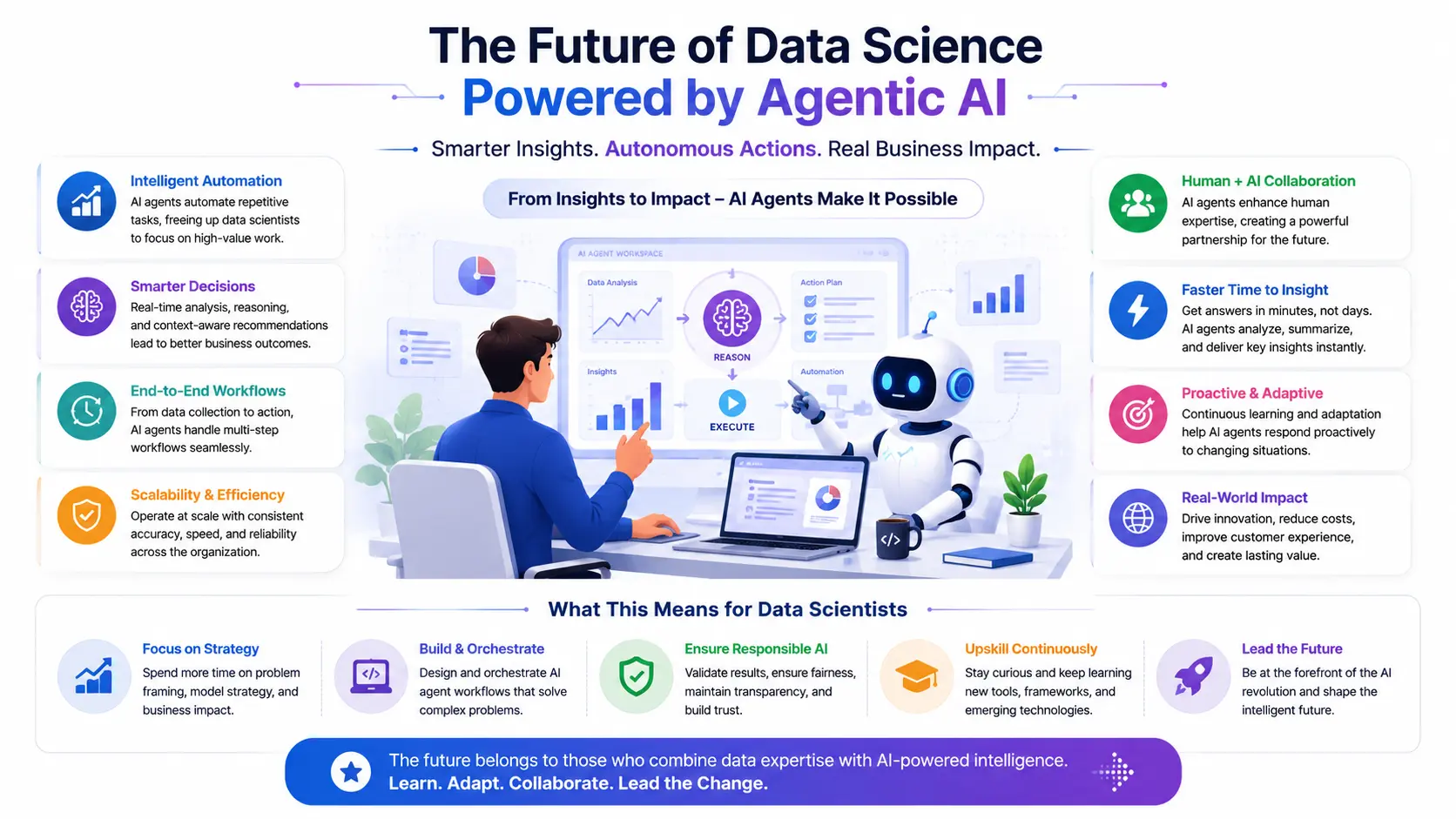
Agentic AI isn't here to replace data scientists.
It's here to replace repetitive work.
Tasks like manually searching dashboards, generating reports, investigating routine issues, and gathering business insights can increasingly be handled by intelligent AI agents. That gives data scientists something far more valuable time to focus on solving complex business problems, making strategic decisions, and creating real impact.
The next few years are going to be incredibly exciting for anyone entering Data Science. New tools will continue to appear, AI agents will become more capable, and workflows will become increasingly autonomous. But one thing is unlikely to change:
Curiosity, critical thinking, and strong fundamentals will always matter more than chasing the latest trend.
The professionals who learn how to work alongside AI rather than compete against it will be the ones leading the next generation of analytics.
So keep building projects, keep experimenting with new technologies, and never stop learning.
🚀 Your future career won't be defined by how many AI tools you know. It will be defined by how effectively you use them to solve real-world problems.
Frequently Asked Questions (FAQs)
Q1. Can beginners start learning Agentic AI today?
Absolutely. Start by building strong foundations in Python, SQL, statistics, and machine learning. Once you're comfortable with those concepts, learning Prompt Engineering, LLMs, Retrieval-Augmented Generation (RAG), and AI agent frameworks becomes much easier.
Q2. Will Agentic AI replace Data Scientists?
No. Agentic AI is designed to automate repetitive tasks such as data exploration, report generation, and workflow automation. Human expertise is still essential for defining business problems, validating AI outputs, making strategic decisions, and ensuring responsible AI use.
Q3. What's the difference between Generative AI and Agentic AI?
Generative AI focuses on creating content like text, images, code, or audio based on prompts. Agentic AI goes one step further by planning tasks, making decisions, remembering context, and executing multi-step workflows with minimal human supervision.
Q4. Which skills are most important for an Agentic AI career?
A strong combination of Python, SQL, Machine Learning, Prompt Engineering, LLMs, Retrieval-Augmented Generation (RAG), AI agent frameworks, cloud computing, and problem-solving skills will prepare you for modern AI roles.
Q5. How are companies using Agentic AI today?
Organizations are already using AI agents for demand forecasting, customer support, fraud detection, workflow automation, intelligent search, business reporting, software development assistance, and enterprise productivity through platforms like Microsoft Copilot.
Q6. Is Agentic AI the future of Data Science?
Agentic AI is widely expected to become one of the biggest shifts in modern analytics. Rather than replacing data science, it expands what data professionals can accomplish by combining predictive analytics with intelligent automation and autonomous decision support.
Continue Your AI Journey
The world of Artificial Intelligence is evolving faster than ever, and staying updated is one of the best investments you can make in your career.
Whether you're exploring Machine Learning, Data Science, Generative AI, or Agentic AI, remember that every project you build strengthens your skills and brings you one step closer to becoming an industry-ready professional.
Explore more practical guides on Artificial Intelligence, Machine Learning, Data Science, Programming, and Career Growth here on InfoShalaa, and keep building the skills that will define the future.