

Introduction: Why Dashboards Alone Aren't Enough Anymore
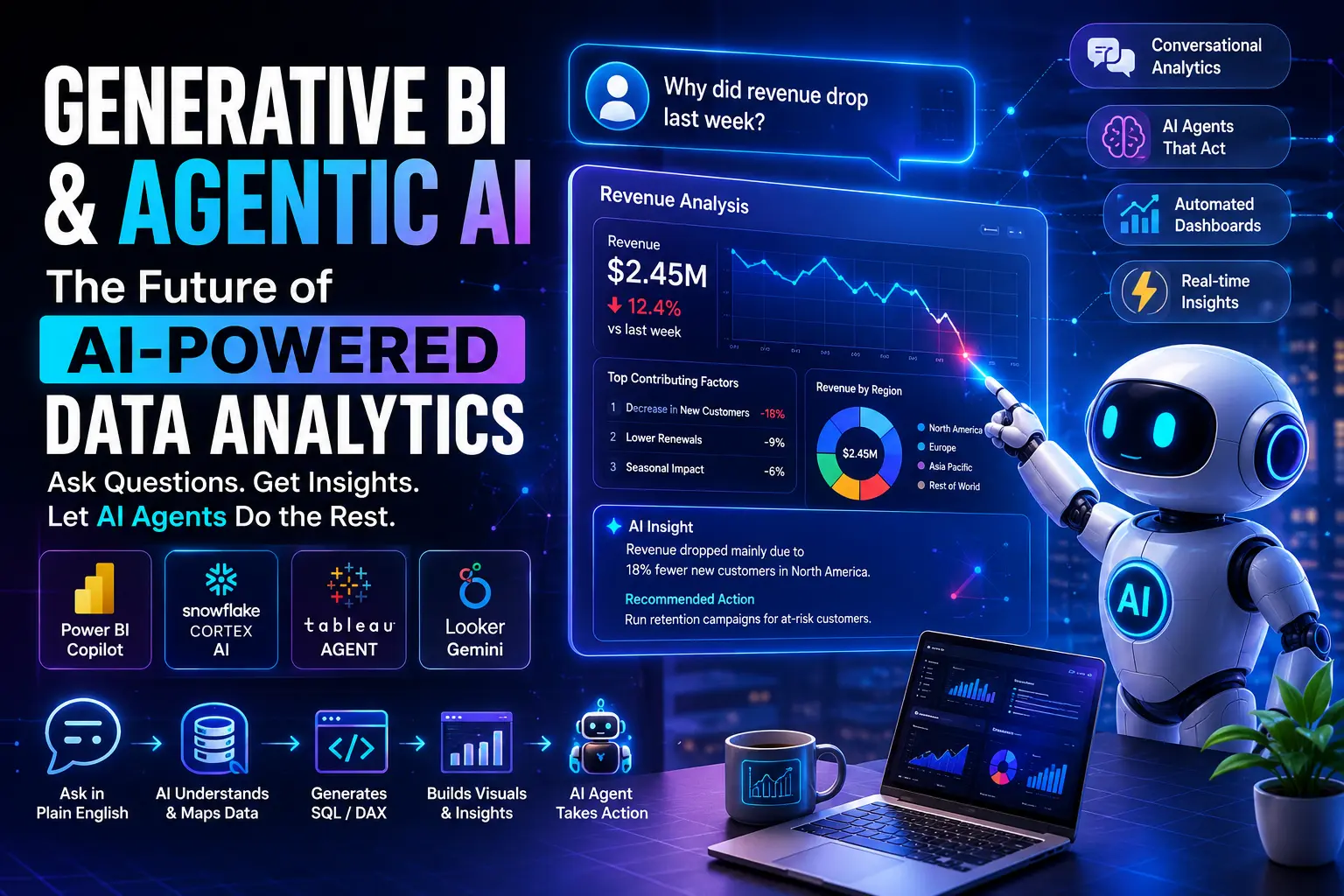
A sales manager opens a dashboard, scrolls through ten charts, and still can't answer one question: why did revenue drop last week?
For two decades, BI meant building dashboards and waiting for answers. That's changing fast.
Businesses now want to ask a question in plain English and get an answer in seconds. This shift is called Generative BI, powered by agentic AI workflowsAI that doesn't just answer, it plans, decides, and acts.
Here's what both actually mean, and why Power BI, Tableau, Snowflake, and Looker are rebuilding around them.
Did You Know?
Gartner projects over 80% of enterprises will have used generative AI APIs by the end of 2026 up from under 5% in 2023.
What is Generative BI?
Generative BI combines traditional BI with generative AI. You type a question in plain language, and the system writes the query, builds the chart, and explains it no SQL or manual dashboard-building required.
Think of traditional BI as a library you search yourself. Generative BI is a librarian who already knows exactly where everything is.
Traditional BI vs Generative BI
| Dimension | Traditional BI | Generative BI |
|---|---|---|
| Query Method | Manual SQL/DAX or filters | Natural language questions |
| Dashboard Creation | Built by analysts, takes days | Generated instantly from a prompt |
| Speed | Hours to days | Seconds to minutes |
| Automation | Manual, scheduled refreshes | AI agents handle prep and alerts |
| AI Capabilities | Suggestions only | Generates and acts |
| Decision Support | Descriptive | Predictive and prescriptive |
Adoption is still early-stage, but the direction is clear: faster answers, less waiting on the data team.
Conversational Data Analytics
The engine behind this is Natural Language Processing (NLP) AI that understands plain language, not rigid query syntax.
Behind the scenes: you ask a question, the AI maps it to the right tables and metrics, writes the SQL or DAX, runs it, and returns a chart with an explanation.
Try asking: "Which product had the highest revenue last quarter?" or "Compare retention month by month for 2026."
💡 Pro Tip
Include a metric, a time frame, and a dimension. "How's marketing doing?" is vague; "Email campaign ROI by region in Q2" isn't.
Copilot in Power BI can build full reports from a description or a screenshot. Snowflake's Cortex Analyst and Tableau Agent do the same for their platforms.
Agentic AI Workflows
Conversational AI answers questions. Agentic AI completes tasks, combining reasoning, planning, tool use, memory, and decision-making.
Ask an agent "Why did churn rise, and draft a fix" and it breaks the goal into steps pull data, segment customers, find the correlation, write a summary without you directing each one.
Example: A logistics firm's agent monitors delivery delays hourly. When delays spike, it pulls weather and traffic data, finds the likely cause, and posts a rerouting plan to the ops team's chat often before anyone notices the dip.
This is the leap from AI that talks to AI that works.
AI Agents Inside Business Intelligence
Inside a BI platform, agents now handle:
- Automatic query and report generation
- Dashboard updates as data or priorities change
- Scheduled analytics without manual refreshes
- Data validation and error detection
Tableau Pulse monitors KPIs and alerts on anomalies automatically. Microsoft Fabric's data agents detect metric changes and trigger follow-up actions on governed data.
Analysts now review and refine AI output rather than building every chart by hand.
Smart Data Modeling
AI needs to understand your data's structure before it can answer correctly:
- Fact tables measurable events, like sales transactions
- Dimension tables descriptive attributes, like customers or dates
- Star schema a fact table linked directly to dimensions (fast, common)
- Snowflake schema dimensions broken into sub-dimensions (more normalized)
Modern AI tools scan a database and suggest a clean semantic model automatically, including key relationships and naming fixes.
A clean model is what separates reliable AI answers from confident-sounding guesses.
Intelligent Data Cleaning
Analysts still spend more time cleaning data than analyzing it. Agentic AI is absorbing that work:
- Flagging and filling missing values
- Detecting and merging duplicates
- Spotting outliers and standardizing formats
The difference from old cleaning scripts is judgment. An agent can recognize that a $0 sales value during a store closure isn't an error while the same value on a normal trading day is.
Intelligent Search & Decision Making
Finding the right data among millions of records relies on:
- Classification & ranking sorting and prioritizing results
- Embeddings & vector search finding records that are semantically similar
- Semantic search understanding intent, not just keywords
- RAG (Retrieval-Augmented Generation) retrieving real data, then generating an answer grounded in it
RAG keeps AI tied to your actual company data instead of guessing from general training. Snowflake's Cortex Search combines vector search with reranking for exactly this reason.
Automated Dashboard Design
Generative AI now handles chart selection, accessible color choices, KPI cards, and layout automatically, from a single prompt.
| Platform | Agentic Capability |
|---|---|
| Power BI / Fabric | Copilot builds reports from text or a screenshot |
| Tableau | Tableau Agent + Pulse handle prep and KPI alerts |
| Looker | Gemini-powered Code Interpreter runs forecasting without Python |
| Snowflake Cortex | Agents reason across structured and unstructured data |
A messy data model is still the #1 reason AI dashboards return wrong numbers clean naming matters more than ever.
Real-World Business Use Cases
- Retail auto-generated reorder alerts before stockouts
- Banking instant, permissioned answers to compliance questions
- Healthcare patient flow summaries without exposing protected data
- Manufacturing predictive maintenance from sensor data
- Logistics proactive rerouting based on live conditions
Example: A regional bank let branch managers ask, "Which products are underperforming this quarter?" instead of waiting on a weekly report and saw sharper follow-up questions as a result.
Advantages
- Faster decisions seconds, not days
- Less manual report-building
- Consistent numbers across teams
- Self-service access for non-technical staff
- Lower reporting costs
Challenges to Watch
- Privacy & security sensitive data must stay inside governed boundaries
- Hallucinations wrong answers when the data model is unclear
- Governance someone must still own metric definitions
- Explainability regulated industries need the "why," not just an answer
Avoid this mistake:
Giving an agent broad access just to "move faster." Start with read-only access on specific tables, then expand once you trust the outputs.
The Future of Generative BI
Expect AI coworkers inside chat tools, dashboards that rebuild themselves, voice-driven analytics, and multi-agent systems coordinating across departments.
Tableau, Snowflake, Microsoft Fabric, and Looker are all converging on one idea: insight shouldn't be the end of the process action should be.
Final Thoughts
Generative BI removes the friction between a question and an answer. Agentic AI removes the friction between an answer and an action.
The tools will keep changing. The skill of asking good questions and validating the answer won't.
Frequently Asked Questions
1. What is Generative BI in simple terms?
It lets you ask business questions in plain language and get an instant answer with a chart, instead of building a dashboard or writing SQL.
2. How is Generative BI different from traditional BI?
Traditional BI needs dashboards built ahead of time. Generative BI generates the query, chart, and explanation on demand, from a single question.
3. What are agentic AI workflows?
AI systems that plan and complete multi-step tasks like investigating a metric drop and drafting a recommendation without a human directing every step.
4. Do I need to know SQL or DAX to use these tools?
No. They translate plain-language questions into SQL or DAX automatically, though knowing the languages helps you validate the output.
5. Which BI platforms support agentic AI today?
Power BI, Tableau, Snowflake, and Looker all offer agentic features through Copilot, Tableau Agent/Pulse, Cortex Agents, and Gemini-powered BI Agents.
6. Can Generative BI hallucinate or give wrong answers?
Yes, especially when the underlying semantic model is messy or undocumented. A clean, governed data model significantly improves accuracy.
7. Is Generative BI only for large enterprises?
No. Large enterprises use platforms like Power BI or Snowflake, while smaller teams often start with lighter, cloud-based conversational analytics tools.
Keep Exploring
Want to go deeper? InfoShalaa has more guides on Power BI, SQL fundamentals, and AI agents to help you build your edge in this fast-moving field.